Share It On:
 AI has commoditized ad bidding, and the old performance marketing playbook is taking a hit. Decision-makers must pivot from ‘buying users’ to ‘building ecosystems.’ This guide clarifies a comparison of funnels, metrics, and strategies.
Marketing spend functions as a direct investment in the long-term success of your mobile application. Many leaders struggle to determine if they are funding short-term gains or building a lasting foundation for their product. While the industry once prioritized high volume at the top of the funnel, privacy changes and rising acquisition costs forced a massive shift in how teams calculate success and manage budgets. Choosing between growth marketing vs performance marketing involves more than budget splits.
An expert app marketing company looks past superficial data like clicks or installs to understand real impact. A thorough performance marketing strategy often generates rapid user surges to meet immediate goals. Yet, without a steady growth marketing funnel, those new users frequently leave before the company sees a return on its spend.
Data from Mordor Intelligence suggests the mobile app market will reach a valuation of $391 billion by the end of 2026 and will reach $864.5B by 2031. Because simple ad tactics no longer suffice for modern businesses, leaders recognize that winning app marketing strategies require a broad view of the entire user journey rather than just bright visuals. This creates a need for deep strategic clarity.
This editorial works as a guide for the growth marketing vs performance marketing strategy. By aligning your goals with these frameworks, you ensure that your application moves beyond a simple launch to achieve a dominant position in the global market.
Growth Marketing vs Performance Marketing: A Comparison Guide
The primary growth marketing vs performance marketing difference lies in the scope and the time horizon. Performance marketing is about getting the user; growth marketing is about keeping and monetizing the user sustainably. Look at the comparison table below to understand the key differences:
| Feature | Performance Marketing | Growth Marketing |
|---|---|---|
| Primary Focus | Immediate Conversions/Sales | Long-term Brand Growth & Retention |
| Funnel Scope | Top & Bottom (Acquisition) | Full Funnel (AAARRR Framework) |
| Core Goal | High ROI on specific campaigns | Sustainable marketing strategies and LTV |
| Data Usage | Optimization of ad creative & bids | Experimentation across product & marketing |
| Time Horizon | Short-term (Daily/Weekly) | Long-term (Quarterly/Yearly) |
| Key Metrics | CPA, CPC, ROAS, CTR | LTV, Churn Rate, Retention, CAC:LTV |
| Typical Channels | Meta Ads, Google Ads, TikTok | SEO, Content, In-app messaging, CRM |
Defining the Core Concepts: Performance vs. Growth Marketing
What is Performance Marketing?

A successful performance marketing strategy functions as a results-based model where a company only issues payment after a user completes a specific task, such as a click or a mobile app install. This method has moved far beyond basic paid search. These efforts rely on highly detailed machine-learning environments that manage automated bidding with extreme speed and accuracy.
This approach focuses on the bottom of the funnel because it remains transactional and fast-paced, requiring teams to monitor performance marketing metrics like Return on Ad Spend (ROAS) and Cost Per Acquisition (CPA) closely. The outcome is a highly trackable system that converts existing demand into immediate revenue.
What is Growth Marketing?

If performance marketing acts as a sprint for quick wins, then growth marketing represents the marathon for long-term health. This discipline covers the complete growth marketing funnel, looking past the first download to help with user activation, long-term retention, and organic referral loops.
A winning growth marketing strategy for mobile apps uses constant testing across the entire user experience to ensure a person remains active on day thirty and beyond. This creates a path toward building real brand advocates. The most effective teams prioritize customer lifetime value over the sheer volume of new downloads.
Growth Marketing vs Performance Marketing Strategy for Mobile Apps
Companies now face a market where Statista projects that the revenue of the mobile app market will be over US$781.70bn by 2029. Visibility alone is insufficient. Business leaders must integrate a dual growth marketing vs performance marketing strategy to remain relevant in this competitive environment while protecting their capital. Success requires a balance. What results is a need to balance immediate customer acquisition with long-term retention efforts to ensure the business remains profitable over the next several years. This creates a sustainable path for mobile applications in a crowded digital space.
Growth Marketing Strategy for Mobile Apps
The modern growth marketing funnel follows the AAARRR framework to manage the entire user lifecycle. In practice, the current focus shifts toward activation and retention. This shift happens because users abandon some of the apps after only one use, which creates a significant loss of potential revenue. A solid growth marketing strategy for mobile apps treats the product as a living entity that must provide value daily to every user. This means teams prioritize mobile app engagement strategies to keep users from leaving early. The effective market strategies include:
- Hyper-Personalized Onboarding: Using AI to tailor the first-time user experience based on the acquisition source.
- Lifecycle Campaigns: Using predictive analytics to send push notifications before a user is likely to churn.
- Community Building: Leveraging a user-generated content marketing strategy to create a sense of belonging among users.
Performance Marketing for App Growth
Current performance marketing for app growth functions as a complex system of data engineering and rapid testing. Privacy rules have reduced the availability of direct tracking signals. Marketers now rely on probabilistic modeling and first-party data to maintain their conversion rates in this new environment. The role of app marketing companies now involves ‘Creative Intelligence’ to maintain efficiency and lower costs. Success requires constant performance marketing campaign optimization to combat rising costs in competitive ad auctions because the system uses automated bidding that changes based on market demand and user behavior data.
Converting the Funnel: Balancing Top-of-Funnel Reach with Bottom-of-Funnel Precision
Every successful mobile application relies on a steady flow of users moving from initial awareness to final action. In practice, the growth marketing funnel requires a deep understanding of both Top-of-Funnel (ToFu) and Bottom-of-Funnel (BoFu) stages. These stages serve different masters. ToFu creates the massive pool of potential interest that feeds the entire ecosystem. BoFu represents the final, narrow point where a person decides to download, subscribe, or buy. Marketing teams that ignore one in favor of the other often see their acquisition costs soar while their user base remains stagnant. The most effective small business marketing strategies treat these as a single, connected journey rather than separate silos.

Top-of-Funnel (ToFu): The Engine of Awareness
The primary goal of ToFu is to build a massive audience that knows your brand and understands the problem your app solves. In a performance marketing strategy, this stage involves casting a wide net to gather data on what creative hooks work best. Growth marketing, however, looks at this through the lens of long-term education and brand equity. The data gathered at the top of the funnel helps refine the AI bidding models used later in the process.
- Educational Content: Companies build trust by solving user problems before asking for a download.
- Influencer Partnerships: Teams work with creators to reach niche audiences that traditional ads might miss.
- Viral Loops: This means creating content that users want to share naturally with their own networks.
- Search Visibility: High-level app marketing strategies focus on being present when users search for broad solutions.
Bottom-of-Funnel (BoFu): The Precision of Conversion
BoFu is the territory where performance marketing truly shines. This is the moment of truth where a potential user becomes a customer. A winning performance marketing strategy at this stage is relentless and highly analytical. One factor is the speed of iteration. What results is a high-pressure environment where every click must lead to a measurable result. This creates the immediate revenue that allows a startup to reinvest and scale further. For those in digital marketing for SaaS, BoFu precision is the difference between a high burn rate and a profitable quarter.
- Direct-Response Ads: These campaigns use clear, high-intent language to drive an immediate app install or sign-up.
- Retargeting Campaigns: Analysis reveals that users often need multiple reminders before they commit to a purchase.
- A/B Testing Bounties: Teams constantly test different landing page layouts and call-to-action buttons to find the highest conversion rate.
- Machine-Learned Bidding: Platforms use real-time data to place your ad in front of the people most likely to convert right now.
The outcome of balancing these two stages is a healthy, sustainable business. While ToFu feeds the fire, BoFu captures the heat. Apps that invest only in BoFu eventually run out of ‘warm’ audiences to convert. Conversely, those who only focus on ToFu may build a large following that never pays. By managing both with clear performance marketing metrics, you create a loop where new interest consistently turns into long-term profit.
Metrics and ROI: Growth vs Performance Marketing
Data acts as the foundation of any professional business choice. If a team cannot track an action, that action carries no weight in the boardroom. Still, the data points for these two areas of work often move in opposite ways. Performance goals usually demand quick results while growth goals require a long view of the customer relationship. Managers who only track the cost of a single download often miss the larger picture of whether that user will ever contribute to the bottom line of the company. This means a leader must look at the full picture of the growth vs performance marketing ROI to keep the business healthy.
Performance Marketing Metrics
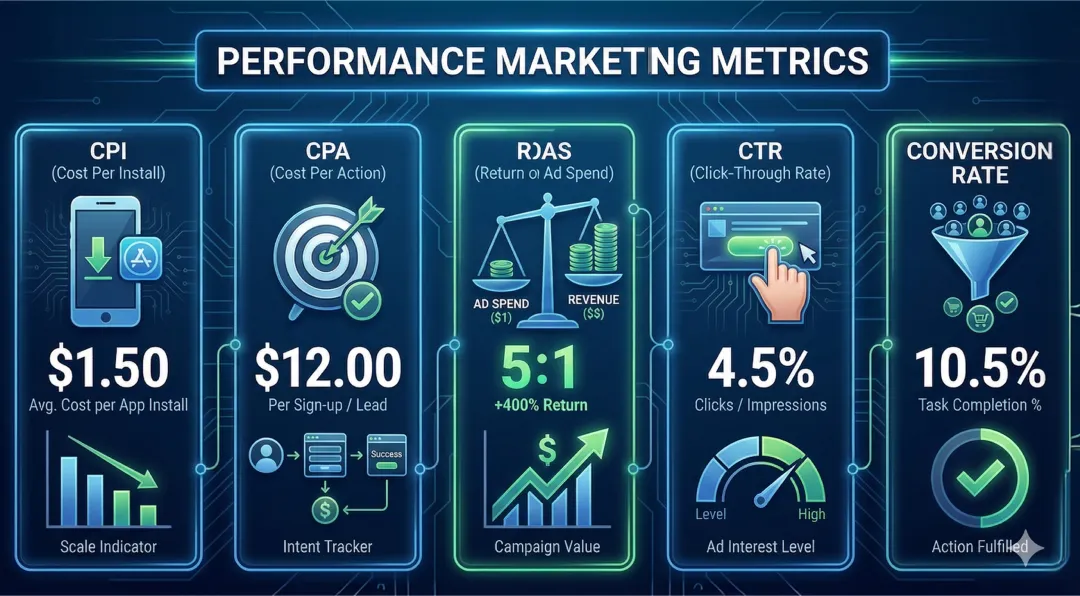
A performance marketing strategy relies on clear, immediate numbers to judge how well an ad spend works right now. These figures allow a business to see if its current path creates a profit or a loss in real time. Decision makers use these performance marketing metrics every day to make fast changes to their budgets and ad creatives.
- CPI (Cost Per Install): This figure shows the basic price a company pays to get one person to put the app on their phone. It serves as the primary starting point for measuring the scale of your outreach.
- CPA (Cost Per Action): This metric tracks a specific goal like a sign-up, a lead, or a trial start. It is a key indicator for digital marketing for SaaS companies that need to see user intent.
- ROAS (Return on Ad Spend): This ratio tells you exactly how much money the business made back for every dollar given to an ad platform. It proves the immediate value of an individual campaign.
- CTR (Click-Through Rate): Teams track this percentage to see how many people found an ad interesting enough to click on it.
- Conversion Rate: This number shows the percentage of people who finish a specific task after they interact with your ad.
Growth Marketing Metrics
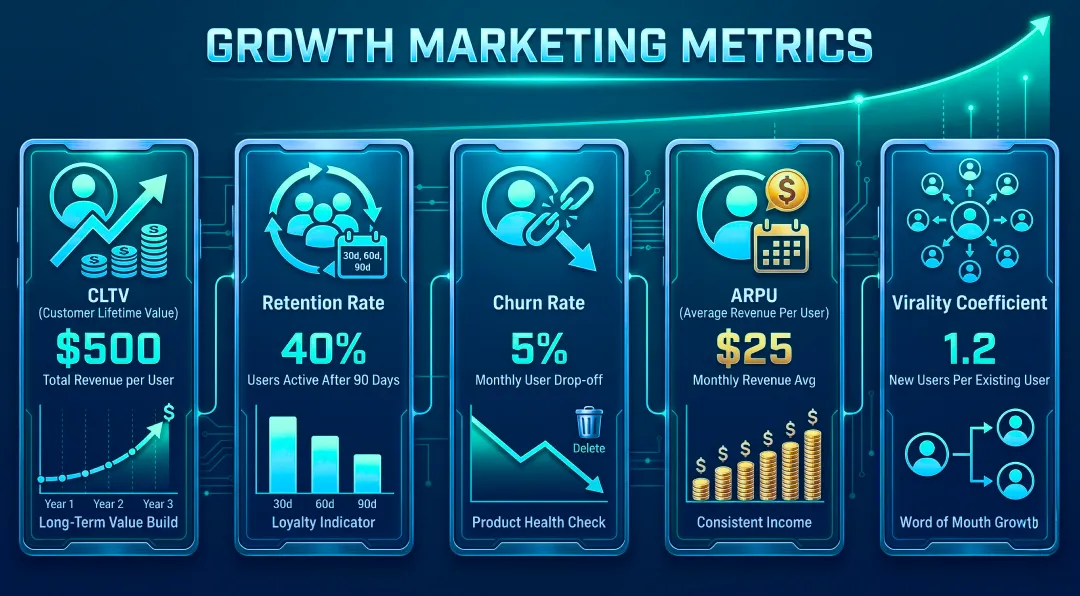
Calculating the results of a growth marketing funnel takes more time because the total value builds up slowly over many months. You have to look at how a user acts long after they join your app, using the metrics to calculate user engagement. This set of data helps a leader know if the business is building real equity or just buying temporary attention that will soon fade.
- CLTV (Customer Lifetime Value): This figure shows the total money one user will spend with your app during their whole relationship with your brand. If this number is significantly higher than the cost to get the user, the business model is working.
- Retention Rate: This tracks how many users stay with the app after thirty, sixty, or ninety days. High retention proves that your mobile app engagement strategies are building a loyal base.
- Churn Rate: This number reveals how fast people delete your app or stop paying for your services. A high churn rate indicates a problem with the product or the onboarding process.
- ARPU (Average Revenue Per User): This tells you the amount of money the average person brings into the company each month.
- Virality Coefficient: This tracks how many new people an existing customer brings to the app for free through word of mouth.
Failure often happens when a team focuses only on the cost of getting new users while ignoring the people who leave. One factor is the cost of staying in the game. This leads to a situation where the company spends more to find a customer than that customer ever pays back. To avoid this, you should use the info from your best mobile app marketing tools to find a perfect balance between speed and loyalty. The best companies match their short-term ad wins with long-term user value to build a brand that lasts.
The New Direction: AI in Growth Marketing and Performance Optimization
AI has moved from a simple trend to a basic requirement for business success. Research from IDC indicates that 60% of F500 firms will use edge analytics and GenAI to map customer journeys by the close of 2027 as part of their broader marketing strategies. This change means that high-level leaders must now view AI in marketing as a key pillar of their operational plan.
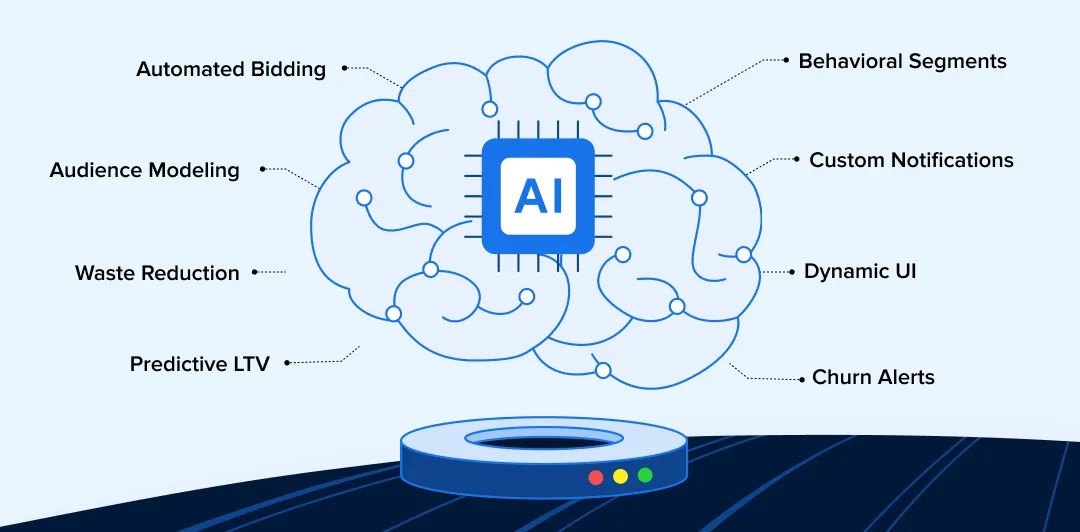
Predictive Analytics for a Sharp Performance Marketing Strategy
Computer intelligence handles much more than just simple content creation today. These tools now drive predictive bidding systems that identify the best users before a brand ever places a bid. Modern platforms look at historical data to find the ‘Propensity to Convert’ for individual prospects in real time.
This process allows for immediate performance marketing campaign optimization by focusing your limited funds on the people most likely to offer a high return. One factor is the ability to shift budgets instantly. What results is a system where your performance marketing for app growth avoids the waste common in older, manual methods.
- Automated Bidding: AI adjusts your bids every second to win the best ad placements.
- Audience Modeling: Systems build profiles of your best customers to find similar people across the web.
- Waste Reduction: Machines stop spending money on groups that show no sign of taking action.
- Predictive LTV: Software estimates how much a user will spend over a year before they even download the app.
AI-Driven Personalization in the Growth Marketing Funnel
Machines now manage the complex tasks of user retention within the growth marketing funnel at a scale that human teams cannot match. This technology chooses the ‘next best action’ for every user based on their unique behavior patterns. The AI does not send a standard alert. Instead, it looks at what that user did in the past. It might send a custom notice about a price change for a stock the user previously viewed.
This level of specific attention is among the most important mobile app marketing trends today. This personal touch significantly lowers churn rates for competitive applications. By applying these best mobile app marketing tools, brands build lasting loyalty.
- Custom Notifications: Users receive messages based on their specific needs rather than a mass schedule.
- Dynamic UI: The app layout changes to show the features a specific user likes most.
- Churn Alerts: The system flags users who are about to leave so the team can help them stay.
- Behavioral Segments: AI groups users by what they do, allowing for much better mobile app engagement strategies.
Choosing the Right Strategy for Your Business Goals
As we have explored, the debate of growth marketing vs performance marketing isn't about which is better, but which is appropriate for your current ‘Goal State.’
- Goal X (Immediate Revenue/Traffic): If your primary goal is rapid user acquisition or meeting immediate sales targets with a measurable cost, Performance Marketing is your priority. It provides the control and speed needed for short-term scale. Use the best mobile marketing software to track every cent and optimize your bids daily.
- Goal Y (Sustainable Brand Growth/Retention): If your goal is to build a sustainable ecosystem, lower your long-term CAC, and maximize user lifetime value, Growth Marketing is the necessary approach. This requires a brand strategy for startups that looks beyond the click.
In the tech-driven world, the most successful apps don't treat these as separate departments. They use performance marketing to fuel the data engine of their growth marketing team. By blending the two, you ensure that today’s ad spend becomes tomorrow’s organic growth.
Frequently Asked Questions
What is the main difference between growth marketing vs performance marketing?
Performance systems prioritize immediate sales through paid media. In contrast, the other model manages the entire user journey. This growth marketing vs performance marketing strategy choice defines your focus. One drives quick revenue while the other builds long-term user equity.
How does a performance marketing vs growth marketing approach impact mobile app scaling?
Direct ad spend provides rapid visibility for new applications. Yet, you must focus on the full growth marketing funnel to prevent high churn. This method moves beyond simple installs. It ensures that your newly acquired users actually stay and pay.
Why should a decision-maker care about a performance marketing strategy for their startup?
Capital efficiency requires proof of concept. Use results-based ads to validate your product-market fit fast. Tracking specific performance marketing metrics like cost per install keeps you lean. It allows you to pivot before you burn through your initial seed funding.
How do you measure a successful growth marketing strategy for mobile apps?
Look past the download numbers. Real success involves tracking retention and lifetime value over several months. Focus on performance marketing campaign optimization to lower your acquisition costs. This balanced view protects your bottom line and ensures your app grows sustainably.
What defines the growth marketing vs performance marketing difference for SaaS companies?
SaaS relies on recurring revenue. While one method finds the lead, the second method secures the subscription. Using performance marketing for app growth captures in-market demand. However, you need deep engagement tactics to keep those professional users from canceling.
How can AI in growth marketing reduce our long-term customer acquisition costs?
Smart algorithms predict user behavior before it happens. This technology automates testing across your entire onboarding flow. It improves your growth vs performance marketing ROI by identifying high-value users early. Machines now handle the complex data tasks that humans often miss.
Is a performance marketing strategy better than growth for short-term revenue spikes?
Yes. Pay-for-play models offer the fastest way to hit quarterly targets. These tactics use aggressive bidding to capture existing search intent. While the growth marketing vs performance marketing difference is clear, you need ads to fuel the initial fire.
How does the growth marketing funnel address user retention issues?
This framework maps every touchpoint after the install. It uses push notifications and in-app events to build habits. Improving your performance marketing campaign optimization helps, but retention requires a better product experience. You must solve user problems to keep them active.
Does performance marketing for app growth still work with new privacy laws?
Tracking is harder now. You must rely on first-party data and probabilistic modeling to see results. This shift changes your performance marketing vs growth marketing balance. You need brand authority to convince users to share their data with your app.

Uncover executable insights, extensive research, and expert opinions in one place.
Related Content